
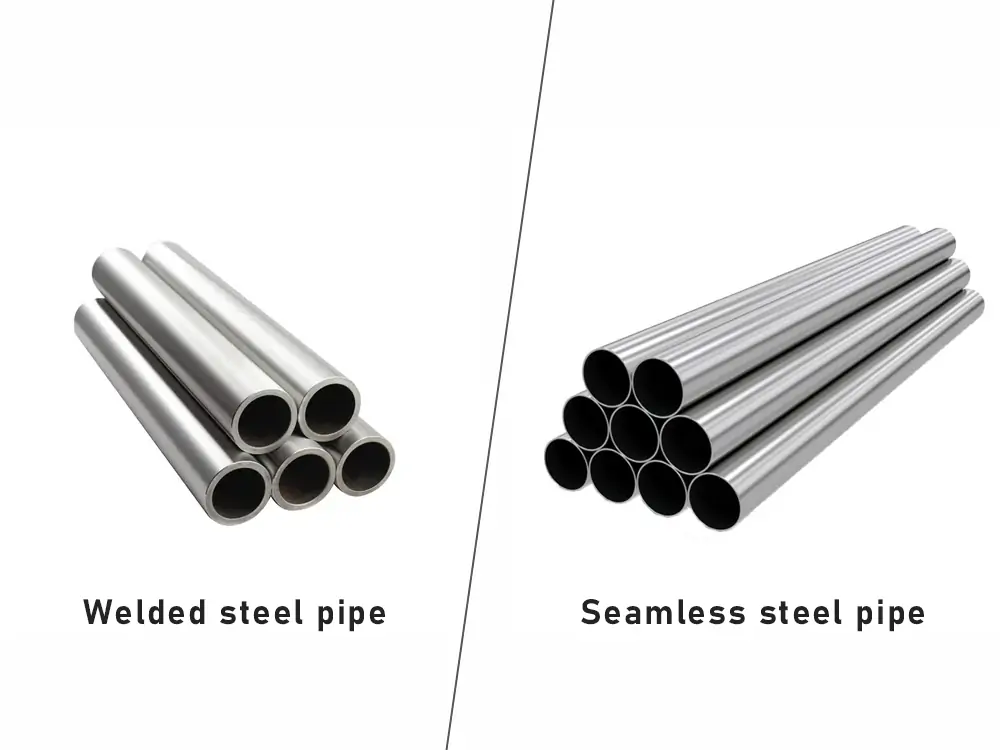
Previously, there were other processes through which people manufactured stainless steel pipes. Steel tubing has become a popular construction material because it does not corrode. There are two methods of manufacturing stainless steel tubes, which include welded and seamless. Such tubing systems can be applied in the transportation of gases and fluids, and that is why they find a wide application in all fields. The two types of pipes are specified in terms of performance, cost, durability, and uses. In this article, you will learn about the differences between welded and seamless steel pipes. Moreover, the details of their manufacturing procedure, types, advantages, and drawbacks should be provided so that the buyer can make an informed decision.
Manufacturing of Welded Steel Pipes
The simple procedure of making a welded steel pipe is folding the steel sheet or strip into a roll or cylindrical shape, and then the edges are welded together. This method will leave a seam on the surface. Two methods are commonly used in manufacturing welded pipes:
- Hot-forming process
- Cold-forming process
Other methods for arc welding can join pipes.
- Gas Metal Arc Welding (GMAW)
- Shielded Metal Arc Welding (SMAW)
- Gas Tungsten Arc Welding (GTAW)
- Flux Cored Arc Welding (FCAW)
- Submerged Arc Welding (SAW)
There are three different kinds of welded steel pipes that are manufactured by using these methods, such as:
- Electric Resistance Welded (ERW)
- Spiral Submerged Arc-Welding Pipe (SSAW)
- Longitudinal Submerged Arc-Welding pipe
Manufacturing of Seamless Steel Pipes
The manufacture of seamless steel pipes takes place by smoothing solid round steel bars. They are more uniform than welded pipes; unlike them, they lack a seam, which is why they are more resistant to pressure and corrosion. The material is heated at 1204/2200°F in a heat furnace. The procedure that is used to manufacture seamless steel pipes is:
- Cold rolling extraction
- Hot rolling extraction
The process hardens the carbon or alloy, which creates a strong product. Different kinds of seamless pipes are used for transporting gas and fluids efficiently:
- Hot-rolled seamless pipes
- Cold-drawn seamless pipes
- Precision seamless pipes
Welded vs Seamless Steel Pipes
Welded pipes or seamless steel pipes are unique due to their associated qualities and properties, such as applications. A welded pipe cannot sustain much pressure due to the weld, whereas a seamless steel pipe can withstand pressure. The table of the differences between seamless steel pipes and welded ones is as follows:
| Properties | Welded pipes | Seamless steel pipes |
| Manufacturing process | The welded pipes also possess a seam on their surface, as such pipes are rolled on a sheet or strip. | In the case of manufacturing seamless steel pipes, they put in a solid bullet that drills a hole through, therefore making it unnecessary to add a welding job. |
| Strength and Reliability | The surface is joined to its pipes, and this makes the surface jointed because it is welded, which compromises the strength. | Seamless steel pipes have no joints, which makes them strong and sturdy. |
| Cost | These pipes are much cheaper | The cost of the seamless steel pipes is much higher |
| Availability | Welded pipes are readily available. | Seamless steel pipes are difficult to manufacture, which is why they are less available. |
| Applications | Welded pipes can be used in industries with low-pressure and low-temperature environments. | Seamless steel pipes can resist high temperatures and high pressure. |
| Production speed | Welded pipes can be manufactured at a higher speed | Seamless steel pipes have a low rate of production |
Advantages and Disadvantages of Welded Steel Pipes
The use of welded steel pipes has many applications in different industries. These pipes have many advantages as well as disadvantages, which are as follows:
Advantages
- Welded steel pipes are the cost-effective solution for manufacturers and users in the industry. These pipes are manufactured by a straightforward method.
- Welded steel pipes are made at a faster rate due to the automated production method.
- As has been observed, the welded steel pipes are lighter than the seamless steel pipes.
- The welded steel pipes have medium strength, i.e., they cannot withstand such high temperatures and pressures. The temperature is 760-870 °C.
- The welded pipes can be made of several lengths. These pipes have a smooth surface internally.
Disadvantages
- The welded steel pipes have their weak point at the point of the weld, which means that the pressure and temperature tolerance change.
- The point of the weld is more susceptible to corrosion or rust.
- Welded steel pipes should not be used in high-pressure and high-temperature conditions and are limited to a few applications.
Benefits and Drawbacks of Seamless Steel Pipeline
- The steel pipes are seamless, free of any weak points and joints, which is why they are constructed to withstand high pressures.
Advantages
- The exterior and interior surface also has a smoother finish on seamless steel pipes; this helps in flowing and is also smarter.
- Seamless steel pipes resist corrosion very well, are strong, and more durable.
- It has high temperature and pressure resistance; hence, it suits high-pressure and high-temperature demands.
Disadvantages
- The cost of seamless steel pipes is very high compared to welded steel pipes.
- There are limited size options available for seamless steel pipe due to its complex manufacturing process.
- These pipes are heavier and have thicker walls than welded steel pipes.
Conclusion
All in all, welded and seamless steel pipes present certain advantages to suit a particular need in the industry. The manufacturers must note that welded pipes are low-cost, slim, and ideal for moderate pressure and temperature needs. Seamless steel pipes are stronger and last longer. They resist corrosion and handle high pressure. Seamless pipes can be costly and difficult to install. Still, seamless steel pipes are worth considering due to their high reliability. Finally, the decision of which one will be more useful will always be based on the application, budget, and performance needs. For expert advice and stainless steel piping solutions, visit our consultants at https://www.hnyasco.com/.