
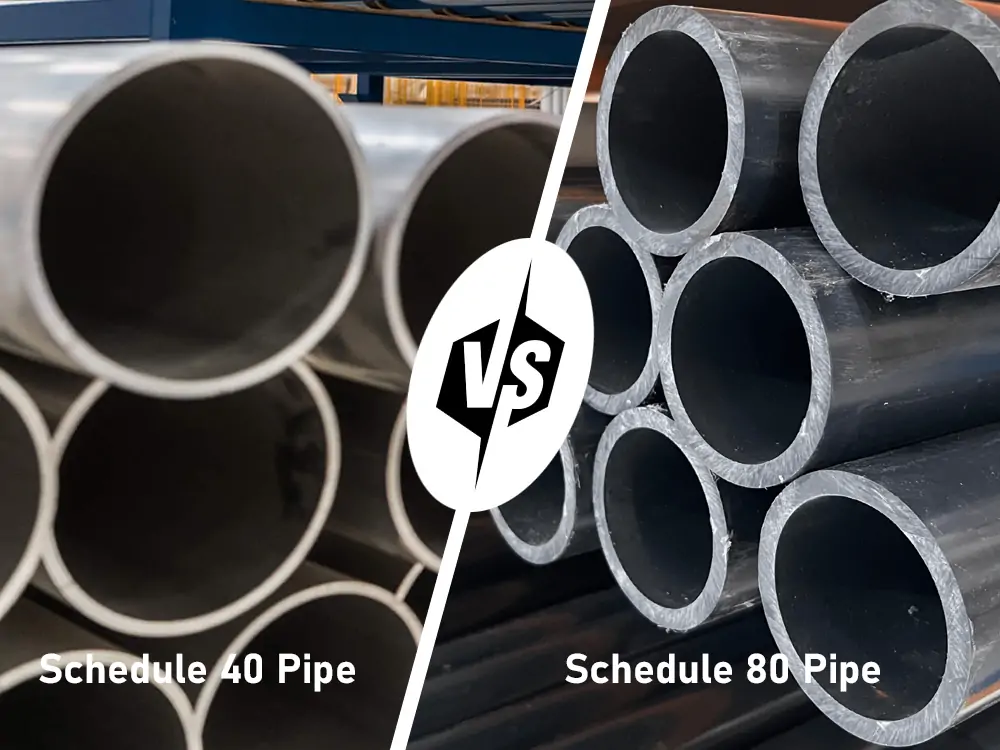
When selecting pipes for a project, diameter is only one of the crucial considerations. Pipe schedule is equally, if not more, important to understand and determine. Schedule 40 and Schedule 80 refer to wall thickness, not size. People often confuse the term “schedule” with pressure rating. That’s not how it works. The schedule number indicates wall thickness, which impacts pressure capacity. Schedule 80 has thicker walls than Schedule 40. That means higher pressure tolerance, but also more weight. Engineers must consider flow rate, pressure demands, and installation method. You’ll also need to factor in cost, which varies sharply. Choosing the wrong schedule can lead to system failure or over-engineering. This article lays out what matters — dimensions, strength, weight, and use cases. Let’s break it down simply and clearly.
What are Pipe Schedules?
Schedules are a standardized way of representing wall thickness in pipes. Contrary to what some might think, it doesn’t have anything to do with a pipe’s diameter. Bigger schedule – bigger pipe? You would be wrong to think that. For example, a schedule 40 and 80 pipe, laid side by side, could look identical. The point of difference? Schedule 80 has thicker walls, but consequently, a lesser flow volume. Pipe schedule is a paramount indicator for engineers. It helps them make correct design choices and match specifications. The term itself was coined in the USA and popularized by the ANSI/ASME standard. There’s a lot you can learn from the schedule, pipe dimension, tolerance, and limits. It’s standard terminology for pipes, whether in plumbing, structural, or chemical engineering. Schedules range from 10 to 160, with some options available. Generally, thicker walls indicate a higher pressure rating. However, you must remember that these are related but not identical concepts.
What is Schedule 40 Pipe?
Among the most common thicknesses, Schedule 40 is often seen in low-pressure systems. Water supply and irrigation are common examples. It’s an excellent Schedule for general applications. You might choose it if you require transportable, manageable, and cost-effective pipes. It has a lesser wall thickness – and hence strength – than a Schedule 80.
But in most cases, this is not a disadvantage. Pipe engineers go for it whenever extreme pressure is not involved. For example, at NPS 2”, a Schedule 40 pipe will have a wall thickness of 0.154”. One must also keep in mind that pressure rating fluctuates by material. PVC, carbon steel, or stainless steel – all will have different ratings even at the same thickness. We recommend that you always refer to your pipe supplier’s pressure table.
Additionally, you’ll find it much easier to slice and thread Schedule 40. It’s even easier to weld. For all these advantages and its versatility, Schedule 40 is a staple in the plumbing industry.
What is Schedule 80 Pipe?
Schedule 80 pipe has thicker walls than Schedule 40. You’ll notice the extra weight right away. It’s built for higher pressure and tougher environments. Industrial systems often require it, especially chemical lines, steam, or compressed air. A 2-inch Schedule 80 pipe has a wall thickness of 0.218 inches. That’s significantly more than its Schedule 40 counterpart. This thickness improves pressure tolerance, but it also adds cost and weight. It also makes cutting, threading, and welding more difficult. You’ll need stronger tools and more labor. Engineers don’t use Schedule 80 unless the job demands it. Stainless steel Schedule 80, in particular, is used in harsh, corrosive setups. The person specifying the pipe must check the pressure ratings by material. Schedule 80 is not about being “better” — it’s about fitting the load. If you overspec, you waste money and complicate installation. If you underspec, you risk failure. Choose Schedule 80 only when the conditions truly require it.
Key Differences Between Schedule 40 and Schedule 80 Stainless Steel Pipe
Wall Thickness and Weight
The most significant difference between the two Schedules is, of course, wall thickness. This is evident directly in the cross-section of the pipe. It also means that for the same nominal diameter, Schedule 80 will be heavier. Added with this extra weight is also a greater pressure rating. Let us demonstrate with a simple comparison. A 1” NPS schedule 40 pipe has 0.133-inch-thick walls. Bump it up to Schedule 80, however, and you have a wall thickness of 0.179 inches. Pipe weight adds up fast with each extra meter – a fact well known to engineers. When managing a project, you will consider many factors. Not the least of these will be transport, handling, and storage. Heavier pipes require heavy-duty brackets and flanges for installation. Overall, load-balancing is also a critical calculation.
Pressure and Temperature Ratings
Pressure and temperature ratings differ sharply between the two schedules. Schedule 80 handles more pressure — that’s the point. You’ll find higher PSI limits across all materials. A 2-inch Schedule 40 steel pipe may handle around 400 PSI. The Schedule 80 version can withstand pressures exceeding 600 PSI under the same conditions. That extra thickness helps contain internal pressure without deformation. Temperature plays a role, too. As heat increases, pressure tolerance drops. You must refer to the derating tables for the exact figures. In high-temperature systems, Schedule 80 holds better structural integrity. He or she designing steam lines, hot oil systems, or compressed air networks often chooses Schedule 80. Schedule 40 can’t safely hold extreme heat and pressure combined. If you’re unsure, don’t guess — verify the operating conditions first. Using the wrong pipe or incorrect rating will cause the system to fail. Choose based on pressure class, not just pipe size.
Inner Diameter and Flow Capacity
The inner diameter affects flow, and Schedule 80 has a smaller one. It’s a direct consequence of their wall thickness. For the same outer diameter, a Schedule 40 pipe has greater flow capacity than Schedule 80. You should observe the trend followed for the inner diameter as well. For a Schedule 40 pipe with a 2” NPS, the ID is 2.067 inches. Looking at Schedule 80, however, it is 1.939 inches. What can this mean practically? Well, if you want to maintain a set pressure, you’ll need larger pipes! This is one of the important tasks entrusted to piping engineers. If you want minimal flow-friction, go for Schedule 40. They are used in irrigation and drains for a reason. Remember, Schedule 80 pipes have trade flow capacity for strength.
Cost and Availability
Schedule 40 is cheaper and easier to source. You’ll find it in every hardware store and industrial catalog. Schedule 80 costs more — sometimes significantly. That’s due to thicker walls, higher material volume, and added manufacturing effort. For the same nominal diameter, Schedule 80 can cost 30–50% more. Stainless steel or specialty alloys? The gap widens further. Availability also matters. Most suppliers maintain a stock of Schedule 40 in all sizes. Schedule 80 is available, but not always in every diameter or grade. The person managing procurement must check the lead times. Delays can hit project timelines hard. You also pay more in transport — Schedule 80 weighs more. That means higher freight charges and handling effort. If you don’t need the strength, don’t buy the bulk. Choose Schedule 40 when pressure conditions allow. Reserve Schedule 80 for when durability justifies the extra cost. Always match material to budget and load.
Applications
By now, you can guess that there is a lot of diversity between their applications in the field. Regarding Schedule 40, you can find them in various types of general-purpose projects. Common implementations include residential plumbing, watering, and sewage drainage systems. Further, they have substantial industrial use too. This includes supply lines, HVAC, and gas transportation. They’re lightweight, modular, and procurable. When it comes to efficiency and availability, Schedule 40 is the contractor’s favorite pipe. Now, when it comes to heavy-duty applications, one needs something extra. Industrial high-pressure systems require specialized equipment. This is the application area for Schedule 80. Common examples are oil & gas, chemical plants, and steam networks. They are durable, robust, and wear-resistant. Schedule 80 pipes are built to withstand mechanical, thermal, and chemical stress. If you are concerned about impact risk, go for Schedule 80 pipes. For harsh environments and corrosion risk, Schedule 80 pipes are the preferred choice. While Schedule 40 meets most domestic requirements, Schedule 80 is designed to meet specialized industrial demands.
Conclusion
The choice between Schedule 40 and Schedule 80 appears to be straightforward at first glance. However, experienced professionals know its nuance. It can greatly influence system performance. It’s safe to say that it goes way beyond simply wall thickness. On one hand, you have Schedule 40. Easy to install, modular, and cheap. It’s your best bet for general-purpose applications. Chances are, it’s the very pipe used in your home. Then comes Schedule 80. It’s heavier and more expensive than Schedule 40. But here’s the thing: it’s absolutely necessary in critical industrial settings. What if you’re dealing with high-pressure fluids? What if your pipes are exposed to corrosive media? What about heavy structural loads like beams and scaffoldings? Schedule 80 is your best friend in such scenarios. Taking the time to analyse requirements can appear laborious, but it can make or break your project. For further questions on pipe schedules, please contact us. Our team of industrial experts will be happy to provide you with a consultation.