
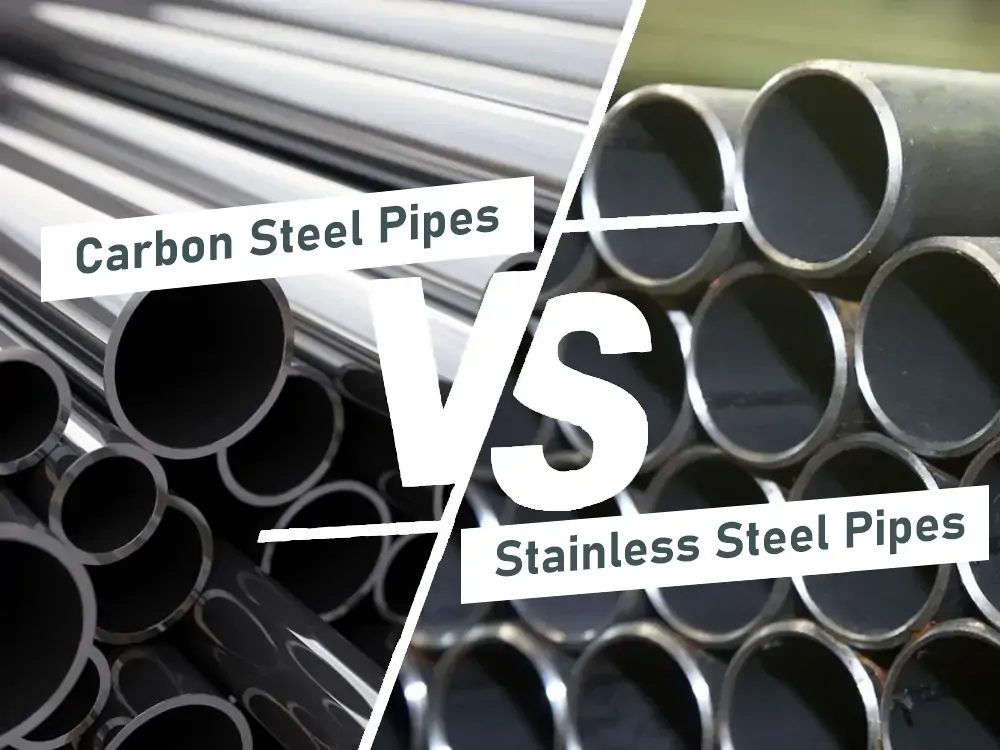
You must choose materials based on the environment and load needs. Carbon and stainless steel serve different mechanical and chemical demands. Carbon steel excels in strength-heavy, high-pressure environments. Stainless steel performs in corrosive, sanitary, or volatile conditions. Engineers use both in oil, water, HVAC, and structural systems. Selection impacts cost, maintenance, and lifecycle performance. Misuse can cause system failure. This article compares both pipe types. It explains composition, grades, strengths, and typical deployments. You will find technical details, not marketing talk.
Carbon Steel Pipe Overview
The chief constituents of carbon steel pipes are iron and carbon. These pipes consist of 0.05 to 2.1% carbon by weight. Additional elements include manganese, silicon, and copper. These influence hardness, strength, and weldability. You must consider the grade before selection. Low-carbon steel is more ductile. High-carbon steel offers greater strength but less flexibility. With superb tensile strength and pressure handling, carbon steel pipes deliver robust applications. They withstand mechanical stress and heavy loads. Thermal conductivity is also favorable. These pipes expand under heat but retain their structure.
You must monitor corrosion levels in exposed systems. Surface treatments can improve durability. Weldability varies by grade. Heavier grades may require preheating before welding. Carbon steel pipes come in several standard types. These include seamless, welded, ERW, and LSAW pipes. Seamless pipes handle high pressure and heat. Welded types suit lower-stress applications. You must choose based on system load. ERW pipes are used in structural and water transport systems. LSAW pipes serve oil, gas, and long-distance transmission networks.
Stainless Steel Pipe Overview
Stainless steel pipes are iron-based alloys with chromium content above 10.5%. It is this very chromium that safeguards stainless steel against corrosion. It does this via a passive oxide layer, which forms at the surface. Nickel, molybdenum, and nitrogen also constitute the list of alloying ingredients for stainless steel. These adjust ductility, creep tolerance, and acid resistance. You must decode the grade system carefully. Austenitic grades are more pliant. Ferritic and martensitic types behave differently under strain.
Stainless steel pipes resist oxidation, pitting, and chemical corrosion. They tolerate wide temperature swings without structural distortion. The surface remains stable in acidic or saline surroundings. You must account for thermal expansion in high-heat settings. Many grades retain form under cryogenic stress. Electrical conductivity is low. Their non-reactive nature suits food, pharma, and sensitive fluid systems. Stainless steel pipes follow specific grade and code systems. Seamless and welded austenitic steel pipes fall under ASTM A312. ASTM A240 governs flat-rolled stainless plates for pipe-making. You may also see API 5L and ISO 3183. These standards guide transport-grade pipes. Grade 304 and 316 are the most used. Selection depends on fluid, pressure, and temperature exposure.
Corrosion Resistance
When it comes to corrosion resistance, there is a huge divide between these materials. This is, of course, due to the properties of stainless steel. It contains chromium, which opposes corrosion. When it forms a passive oxide layer on its surface, it becomes impervious to rust. It also negates a certain amount of pitting and chemical wear. If you need defence against salt and acid exposure, stainless steel is your best bet. Carbon steel, on the other hand, performs poorly in comparison. In reactive environments, it is especially susceptible to rusting. It is essential, therefore, to galvanize carbon steel pipes outdoors. Safety isn’t guaranteed, though, as corrosion can occur at welds or joints.
With stainless steel, however, you can rest easy. It doesn’t require you to fret over regular painting and galvanising. Rust is undesirable in almost all conditions. With its inherent inertness, stainless steel reduces the chance of contamination. Ultimately, the right choice for you boils down to a few questions. Try to factor in the water quality, pH, and ambient humidity. These conditions can hugely determine the long-term performance of your piping system.
Strength and Durability
Your steel grade largely determines its strength, but the trends are quite clear. Carbon steel has a higher yield and tensile strength in general. It’s got solid performance under shock and impact. It handles vibration well, too. Stainless steel is also quite strong, but less so than high-carbon steel. Ultimately, here too, the choice comes down to your use case. Each pipe class has a different pressure rating. Refer to this for more clarity.
While carbon steel is good at raw strength, stainless steel also has its benefits. It particularly shines in thermal cycling. In corrosive environments, it performs better than carbon steel. Here’s a question: What kind of stress will your pipes bear? Answer this question, and you will acquire the right pipe. Both kinds of steel perform differently under different kinds of stress. Therefore, it’s essential to know what your application requires: compressive, tensile, or cyclic?
Cost and Availability
Even for the largest companies, cost and availability are important drivers. Why, you might ask? Well, the availability of certain materials can impact your project timeline. Carbon steel is cheaper and more available per unit weight. It has minimal alloying elements and needs simpler processing. Stainless steel, on the other hand, needs chromium, nickel, and even molybdenum. However, when it comes to expenditure, many people overlook lifecycle cost. Stainless steel requires less maintenance and repair. It has a longer lifespan, and hence a greater return on investment. Carbon steel may fail in corrosive environments. In terms of availability, however, carbon steel pipes come in a huge variety.
What might set you back, however, is lead time. If your project deadline is near, you should choose stainless steel suppliers carefully. Another factor that affects cost is order volume. The next big choice is between welded and seamless pipes. Both have different use cases, and the price differs. Finally, consider things like transport, hand-offs, and fabrication. All these factors quietly add to the cost.
Maintenance and Lifespan
Whether you are a structural engineer or a piping professional, you should never overlook maintenance. Timely servicing can elevate any pipe to its highest quality. With carbon steel, you will need regular rust, leak, and scaling inspections. Protective coatings are highly recommended. It is beneficial to be aware of scheduled shutdowns. With stainless steel, you can be comparatively stress-free. Its inherent properties prevent corrosion. You must still monitor stress cracking. In chlorinated environments, stainless steel can still pit. Pipe lifespan is highly dependent on fluid, temperature, and pressure. With maintenance, carbon steel can last up to 25 years, while stainless steel can endure for 50 years.
An important thing to plan out is cleaning cycles. It is crucial for preventing chemical damage. It maintains joint integrity in piping systems. If your pipe corrodes, replacement operations will add to labor costs and downtime. Stainless steel, in comparison, has more upfront cost but greater operational life. As a decision-maker, you must calculate the total cost of ownership. In short, if the conditions are stable, you can go for carbon steel without worry. For more aggressive environments, stainless steel is the ideal choice.
Application Areas
Application areas of carbon and stainless-steel overlap and diverge. They are highly dependent on load types, heat, and fluids. Caron steel is preferred for structural jobs. They manage gas and steam transportation excellently. For this reason, boilers, HVAC, and fire departments use carbon steel. Even in refineries, carbon steel is used in non-corrosive zones. Carbon steel pipes are mainline transportation in water treatment plants. Stainless steel pipes are perfect for transporting corrosive fluids or marine implementation. Therefore, they make up critical components in desalination plants. Other critical areas of implementation are food processing and cleanroom systems.
Its important to be aware of the properties of these materials. Simply because stainless steel is inert does not mean it’s a one-size-fits-all. For example, it does not perform well in abrasive and high-impact conditions. Pipe materials occupy different niches. A crucial job of piping engineers is to recognize which steel suits their particular application. Regulatory standards impact material decisions. So do site conditions, safety requirements, and system type.
Conclusion
Material selection must match system requirements and environmental load. Carbon steel offers low cost, easy fabrication. Its excellent for its strength. Stainless steel is chemically inert and corrosion resistant. These are important qualities for any piping system. That being said, no single material fits every situation. Each has performance limits and trade-offs. An engineer’s final selection always considers regulatory standards and safety checks. How does a pipe behave under certain kinds of stress? These questions require proper deliberation. Stainless steel is ideal where purity and durability are essential. Carbon steel is better in rugged, contained environments. Engineering judgment must guide material choice. This comparison offers baseline knowledge for decision-making. You must now evaluate your system specifics. The right pipe is not always obvious, but it becomes clear with data-driven decision-making.
Hunan Yasco – Your Trusted Stainless Steel Pipe Manufacturer
At Hunan Yaso Engineering Materials, we provide premium-grade stainless steel pipes worldwide. Our history spans over twenty years. It has been full of R&D, rapid growth, and customer satisfaction stories. With production facilities in Fujian and Zhejiang, we produce a whole range of piping solutions. We have developed high-quality manufacturing methods for seamed and seamless pipes. Further, we have a suite of stainless-steel flanges, fittings, and piping equipment. At Hunan Yasco, we keep the customer at the forefront. Our customizable manufacturing methods match your needs with our skills. We help meet your size, thickness, and material requirements. For an in-depth consultation, please contact our team of experts. They are eager to help you achieve your goals.