
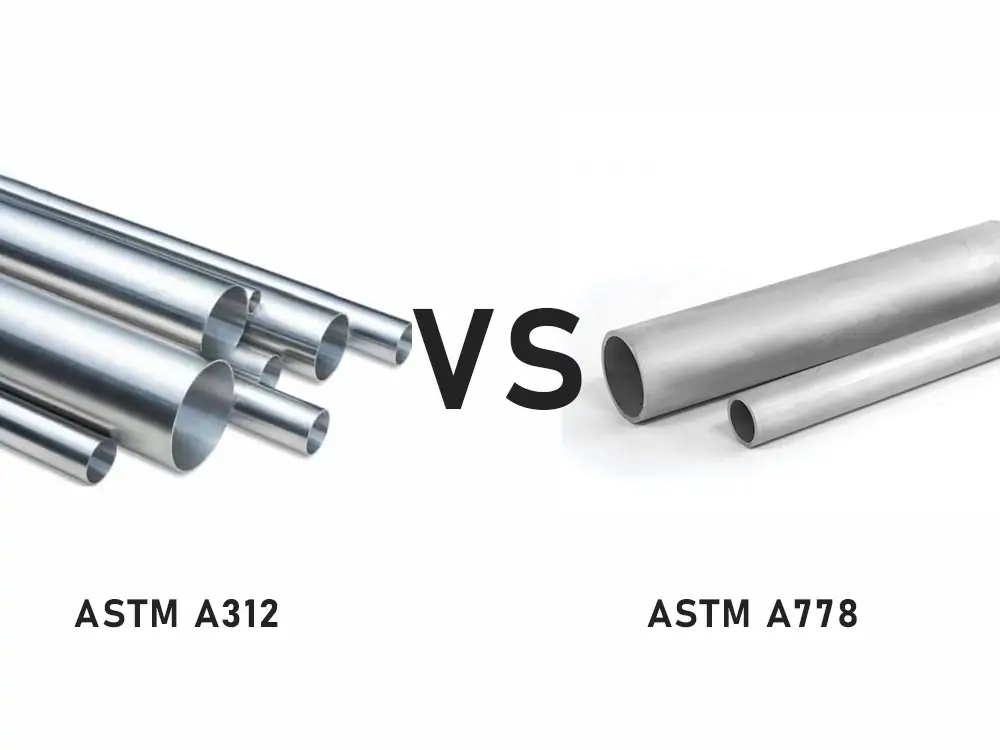
Specifications such as the ASTM (American Society of Testing and Materials) on stainless steel pipes may enable individuals to determine the durability, reliability, and corrosion resistance of the pipes. The most widely demanded specifications are ASTM A312 and ASTM A778. These two types are used during the manufacturing of austenitic stainless steel pipes. This paper will inform you of the differences between ASTM A312 and A778 to help you make an informed choice when it comes to what you require.
Overview of ASTM A312
The stainless steel pipes that have seamless, straight-seam welded, and are heavily cold-worked austenitic are specified in ASTM A312. These pipes can be used in oil and gas, power generation, and petrochemical industries because they have excellent strength and corrosion resistance. ASTM A312 is manufactured by hot forming, cold working, and welding, and further heat treatment increases its strength.
Overview of ASTM A778
The stainless steel pipes are welded from unannealed austenitic stainless steel tubing, which is specified for ASTM A778. These pipes have applications in low-pressure and non-critical corrosive industries. Different standards of pipes 304, 304L, 316, and 316L are prepared by using Electric Fusion Welding. These pipes with all these specifications are used in food processing, water treatment, and architectural structures.
Differences Between ASTM A312 and A778
ASTM A312 and ASTM A778 have many differences. These differences are as follows:
· Material Composition
The main difference is the material that is used in manufacturing the main kinds of stainless steel pipes. ASTM A312 is made from chromium-nickel alloy with very low carbon content. ASTM A778 uses titanium for stabilization. All of the grades, such as 304, 304L, 316, and 316L, are made from these materials. A312 is a heavily cold-worked pipe that has additional strength due to the carbon content in its manufacturing. On the other hand, A778 does not require cold-working.
Manufacturing process
The manufacturing process of both A312 and A778 is different, as they have different specifications. Hot and cold rolling, extrusion, and welding are used to manufacture ASTM A312. At the same time, electric fusion is used to make A778, which can make the end product more tensile and reliable. A312 requires post-weld heat treatment for extensive finishing, while A778 does not require such treatment to enhance its strength.
Annealing
The process that is used to increase the ductility and flexibility of the A312 and A778. A metallurgical process in which the material is heated at a specific temperature and held at that temperature for a period, and then cooled at a controlled rate. A312 requires final annealing for welded and cold-worked pipes. This process will reduce the residual stress that is typically not a requirement for A778, unless the customer demands it. This process provides corrosion-resistant properties to the stainless steel pipes.
Testing standards
Different tests can assess the quality, strength, and durability of the material used in manufacturing. ASTM A312 requires rigorous testing, such as:
- Hydrostatic tests
- Tensile testing and flattening tests
- Bending test
While ASTM A778 does not require such testing, it only requires:
- Hydrostatic testing
- Non-destructive testing
Mechanical Properties
A312 is preferred in high-pressure applications due to its greater mechanical strength than that of A778. ASTM A312 can withstand high temperatures and pressures, while A778 is better suited for low-duty tasks.
| Properties | A312 | A778 |
| Tensile strength | 515 MPa to 690 MPa | 365 MPa to 515 MPa |
| Yield strength | 205 MPa | Minimum 205 MPa (30 ksi). |
| Elongation | A few degrees of elongation | Specific grade under heat treatment |
Wall thickness and tolerances
The tolerance of dimensions, especially wall thickness and ovality, is more stringent with ASTM A312 pipes. Such close tolerances will provide improved pressure management and mechanical strength.
| Properties | A312 | A778 |
| Wall thickness | ±10% of the specified wall thickness | 0.062 in. (1.5 mm) to 0.500 in. (12.5 mm) |
| Outside Diameter (OD) | ±0.1% of the specified OD | ODs from 3 in. (75 mm) through 48 in. |
Cost
The cost of the product depends on the raw material that is used in manufacturing. As A778 is much cheaper than A312. A312 is expensive because of its
- Chromium alloy is much expensive and requires quality raw materials
- Manufacturing processes are very complex
- Heat treatment and testing are required
Applications
A312 and A778 can be used in various industries:
| A312 | A778 |
| Petrochemical plants | Chemical and food processing plants |
| Steam and heat exchangers | Water treatment and plumbing systems |
| Pressure vessels | Structural and decorative tubing |
| Refineries and boilers | Low-pressure fluid transport systems |
When choosing between A312 and A778, the specific requirements, like mechanical strength or pressure, are met. A312 is to be used when the manufacturer needs high mechanical strength. The best option to use when low pressure is wanted is A778.
Conclusion
Whether to use ASTM A312 or ASTM A778 stainless steel pipes depends on the intended use. The ideal conditions under which the ASTM A312 tubes could be used are generated by the high-pressure, high-temperature environment. ASTM A312 performs well in such extreme environments due to its toughness, corrosion resistance, and many other strengths in testing and industrial production environments. In comparison, ASTM A778 is cheaper, thus very suitable in low-pressure applications. It is also suitable for general-purpose applications where they do not require this kind of strength, but they may only require some intense tests. To cater to these particular needs, you must consider the possibility of hiring a certified engineer or provider. This will ensure that the correct standard is selected, which would be less dangerous and cost-efficient.