
The use of standard pipes has vast applications in many areas, from construction to plumbing. Selecting the appropriate type can make a significant difference in the project’s duration. There are various pipes available on the market that manufacturers produce for customers to use in different areas. SCH 20, SCH 40, SCH 40S, and SCH 80 are categorized based on their wall thicknesses.
You can read several comparison articles below:
In this article, you can find information about the differences between SCH 40 and SCH 40S pipes. The primary difference lies in the choice of material and the standards used and followed in manufacturing these pipes.
What is a Pipe Schedule?
To understand the pipe schedule, it is necessary to recognize that different pipes have varying thicknesses. The pipe’s wall thickness is specified using a defined system. The acronym SCH stands for schedule, and it is typically followed by a number such as 10, 20, 30, or 40. The greater the schedule number, the greater will be the wall thickness of the pipe. Therefore, it is evident that SCH 40 has a greater wall thickness than a SCH 20 pipe.
Stainless steel pipes have applications in different industries, like oil and gas, petroleum, plumbing, and construction. The engineers and contractors select the pipes according to their ability to withstand the temperature, pressure, and chemical reactions.
What is SCH 40?
The American National Standards Institute and the American Society of Mechanical Engineers have determined a specific wall thickness for SCH 40 pipes. Sch 40 indicates the wall thickness and its nominal size. The SCH 40 pipe can withstand low to medium pressure, making it suitable for use in water pipelines. These pipes are a cost-effective solution for construction purposes.
These pipes come in a variety of materials, including steel alloys and carbon steel. The wall thickness varies with the pipe diameter; the standard thickness of SCH 40 pipe wall is 4mm.
What is SCH 40S?
The wall thickness for a SCH 40S pipe is the same as that of SCH 40 pipes, but the pipe size is usually smaller compared to SCH 40. These pipes are made of stainless steel, so they have high tolerance for high temperature, pressure, and chemical reaction. SCH 40S pipes have applications in the petrochemical and chemical industries due to their high resistance to rust and tear.
A SCH 40S pipe with a 2-inch size has a wall thickness of almost 2.77 mm. The wall thickness is lower compared to SCH 40 pipes, but the tolerance increases due to the change in material. But SCH 40S stainless steel pipes have a greater wall thickness as compared to standard pipes in use.
What does the ‘S’ in the pipe schedule stand for?
It might grab the reader’s attention that an “S” is designated with SCH 40. The S in the SCH 40S indicates the material used in making these pipes. The material is stainless steel. These pipes are made of stainless steel, which is important to note because stainless steel has properties that make the pipes suitable for use in various industries.
Stainless steel has a great ability to resist corrosion, and it has greater pressure and temperature tolerance. Therefore, the addition of “S” has enabled the manufacturer and engineer to select a pipe that is ideal for their needs.
Differences between SCH 40 and SCH 40S
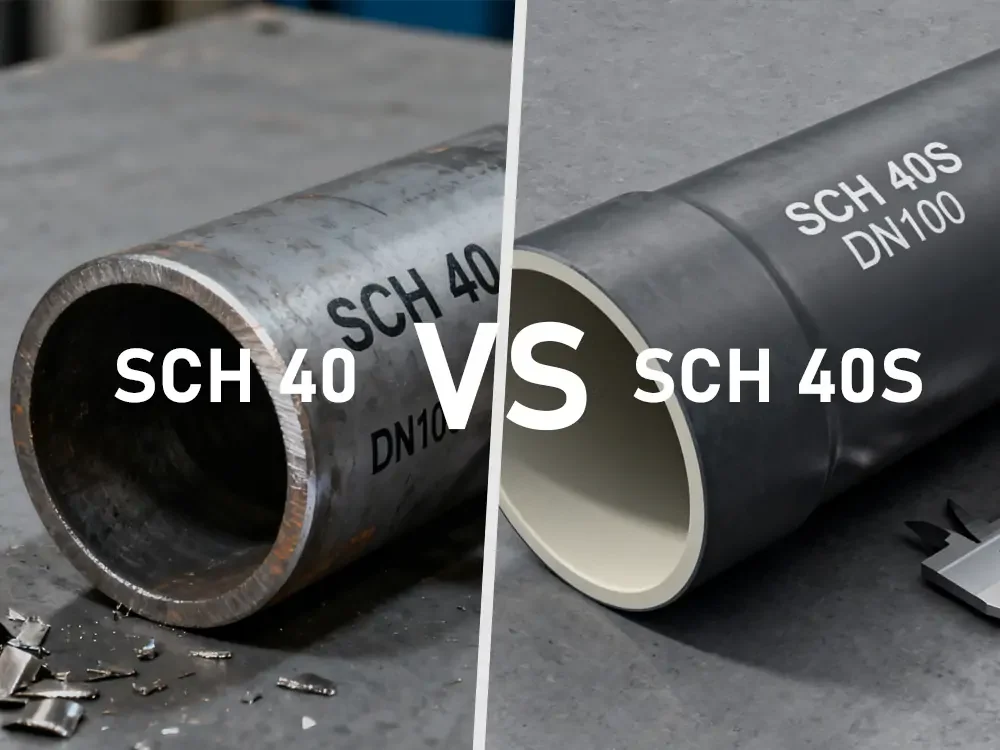
Some features make these two SCH 40S and SCH 40 pipes different. Here is the detail of some differences:
1. Standards
Less precise measurement is required when making SCH 40 pipes, whereas SCH 40 S pipes are made by following the ASME B36.19 standard to ensure accuracy in wall thickness.
2. Wall thickness
The outer diameter is the same for both SCH 40 and SCH 40S pipes. But the difference lies in the material. If the outside diameter of a Sch 40 or Sch 40S pipe with an NPS of 6 is 6.625 inches (168.3 mm), and the wall thickness is 0.280 inches (7.11 mm).
3. Material
- The main difference between the two pipes is the material used in making them. SCH 40 is manufactured using carbon steel. Wrought iron or steel alloys.
- SCH 40S pipes are made from stainless steel, which makes the pipe corrosion and pressure resistant.
4. Applications
- A pipe having SCH 40 wall thickness has low to moderate pressure tolerance. Therefore, SCH 40 pipes can be utilized in various applications, including construction, plumbing, and process piping.
- On the other hand, SCH 40S has a greater ability to tolerate high temperatures and pressures, and it exhibits greater corrosion resistance. These pipes are suitable for use in the oil and gas, petroleum, and chemical industries.
Conclusion
The primary distinction between SCH 40 and SCH 40S pipes is the material and the application of the pipes. Although both have almost the same wall thicknesses, SCH 40 pipes are usually manufactured using carbon steel or steel alloys and are commonly used in construction and plumbing applications. Conversely, SCH 40S pipes are fabricated from stainless steel, making them highly resistant to corrosion, pressure, and temperature. The awareness of these differences enables engineers, contractors, and manufacturers to select the appropriate type of pipe for safe, long-lasting, and efficient project execution.